


The Impact of Digital Media on Young Dancers’ Self-Esteem and Identity Development

Updated: Jul 23
Digital media has changed the way young dancers experience the dance world.
The studio is no longer the only place where children watch, learn from and compare themselves with other dancers. Performances, training clips, competition results and carefully selected photographs are available throughout the day, often presented without much context.
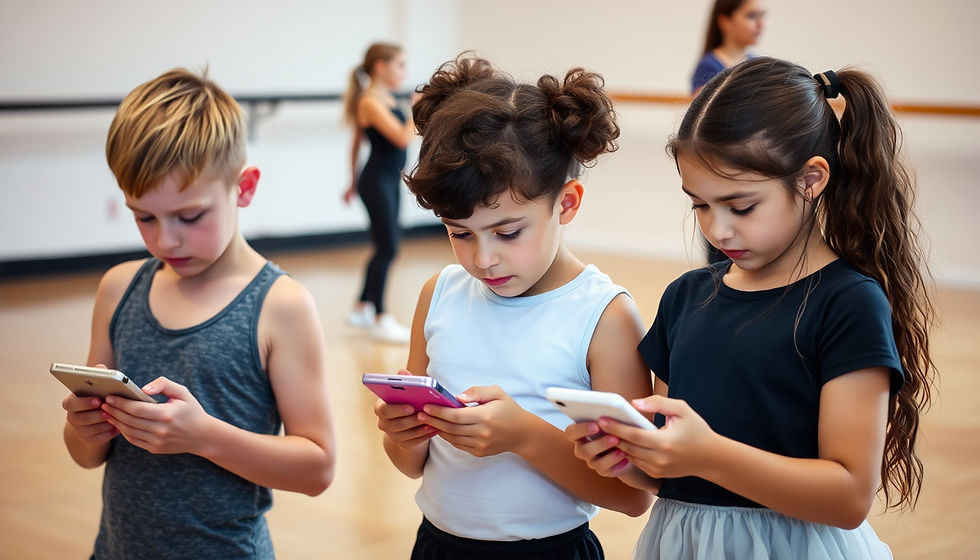
This can be inspiring. Young dancers can discover new ideas, follow dancers they admire and feel connected to a wider community. They can look back at their own progress and share moments they are proud of.
There is another side to this, however, and it deserves more attention than it sometimes receives.
Children and teenagers are still developing their sense of identity. They are learning how they feel about their bodies, their ability and their place within a group. When dance becomes closely connected with public visibility and online response, that development can be affected by an audience that is far larger and less predictable than the one inside the studio.
When Progress Becomes Public
In the past, a difficult lesson or disappointing performance usually remained within a relatively small circle. Today, a video can be recorded, shared and judged within minutes.
For some young dancers, this feels exciting. For others, it creates an awareness that they are being watched even when they are still learning.
The number of likes, comments or views can begin to feel like a measure of success. A post that receives less attention than expected may be experienced as rejection, even when the response has little to do with the quality of the dancing.
This is particularly difficult for children because they do not always have the maturity to separate online reaction from personal value. A young dancer may understand intellectually that likes are not important and still feel deeply affected when a post is ignored or criticised.
The purpose of sharing can also change over time. A child may begin by posting because they enjoy dancing, then gradually become more concerned with what will attract attention. Choices about music, styling, choreography and presentation can start to be shaped by visibility rather than by what is appropriate for the dancer’s age, development or training.
The Effect of Constant Comparison
Comparison has always existed in dance. Children notice who is placed in the front, who learns quickly and who receives praise. Competitions make differences visible, and this can be difficult enough to manage without an online world added to it.
Digital media extends that comparison far beyond the child’s own class or age group.
A twelve-year-old may be watching older dancers who have had many more years of training. They may also be watching professional performers, highly edited routines or short clips selected from numerous attempts.
None of this is necessarily explained to them.
What they see is the finished image. They do not see the failed attempts, the careful editing, the physical maturity or the experience behind it.
When that context is missing, a child may judge their ordinary learning process against someone else’s most polished moment. This can create frustration and self-consciousness at an age when confidence may already be unsettled by physical development.
The comparison is not only technical. Young dancers also absorb ideas about appearance, body shape, presentation and what a successful dancer is supposed to look like. Repeated exposure to a narrow range of bodies or heavily styled content can influence how a child sees themselves before they are old enough to question what they are being shown.
Learning to Perform for the Camera
There is also a difference between learning to dance and learning to produce content.
A dancer may begin to favour movements that look impressive in a short clip, even when those movements are not the most useful part of their development. Training can become interrupted by repeated recording, reviewing and filming again.
Some children become very aware of the camera. Their attention shifts from the teacher, the music or their partner towards how the performance may appear on screen.
This does not mean filming is always harmful. Video can be a useful learning tool, and recording progress can be encouraging. The difficulty begins when the camera changes the purpose of the lesson or when a child feels that every stage of their development must be made public.
Children need places where they are allowed to learn without being presented.
They need to be able to make mistakes, look awkward, change physically and work through uncertainty without feeling that these moments may be recorded and shared.
Adults Also Shape a Child’s Digital Identity
Discussion about young people and social media often focuses on what children choose to post. In dance, adults are frequently involved in creating that online presence.
Parents, teachers, studios, organisers and dance partners may all share photographs or videos of a child. The intention may be entirely positive, but the child’s digital identity is still being created.
A child may enjoy the attention at the time and feel differently about the content later. They may not fully understand how widely an image can travel, how long it may remain available or who may save and reuse it.
Consent therefore needs more thought than simply asking whether a child is happy to be filmed in the moment.
Children should be given clear information about where content will be posted and who may see it. They should also be able to change their mind without feeling that they are letting down a parent, teacher or studio.
Adults need to consider whether every result, performance or training moment needs to be shared. A child’s participation in dance does not automatically make their development public property.
The Pressure to Remain Visible
Social platforms reward regular activity. This can create a feeling that dancers must keep posting in order to remain relevant.
For a young dancer, that pressure may sit alongside school, training, competitions and the ordinary need for rest. Time that might once have been used to recover can be spent recording, editing, checking responses or worrying about what to post next.
Periods surrounding competitions can be particularly sensitive. A child may already be dealing with nerves, expectations and comparison. Seeing other dancers’ final rehearsals, costumes, travel plans and confident messages can add to that pressure.
Some children cope well with this. Others may benefit from stepping back from social media before and after important events.
It is worth paying attention to changes in behaviour. Repeated checking, distress about engagement, reluctance to post an imperfect performance or a sudden drop in confidence may suggest that digital media is no longer serving the child well.
Supporting a Healthier Relationship with Digital Media
The aim does not need to be removing digital media from a young dancer’s life. It is more useful to help children understand what they are seeing and how it affects them.
Parents and teachers can talk openly about why content is shared and what the child hopes to gain from it. A post made to keep a personal record of progress has a different purpose from one created mainly to attract approval.
It is also helpful to explain how online content is selected and edited. Children need to know that a polished clip may have taken several attempts and that many dancers share only the parts of their training that went well.
Privacy settings should be reviewed regularly rather than treated as a one-off task. Adults should know who can view, comment on or share a child’s content. Personal details, regular locations and training schedules should be considered carefully.
Children can also be encouraged to keep some records privately. A personal collection of videos may allow them to see their improvement without making every stage of that progress public.
Most importantly, conversations about digital media should not happen only after a problem appears. Children need regular opportunities to say how online content makes them feel and whether they are comfortable with what is being shared about them.
Protecting the Child Behind the Dancer
Digital media can offer young dancers genuine opportunities. It can widen their knowledge, help them stay connected and allow them to celebrate work they value.
It can also place adult forms of visibility and judgement around children who are still developing.
The question is not simply whether social media is good or bad for young dancers. It is whether the adults around them are paying attention to how it is being used, what it is beginning to influence and how the child is responding.
A young dancer’s confidence should not depend on whether a video performs well online. Their identity should have room to develop away from public reaction, and their less polished stages of learning should not always need an audience.
The dancer may be visible, but the child still needs protection.
Feedback and corrections
We welcome thoughtful feedback, corrections and suggestions for future topics. Please contact us at info@dancesporttrust.org


